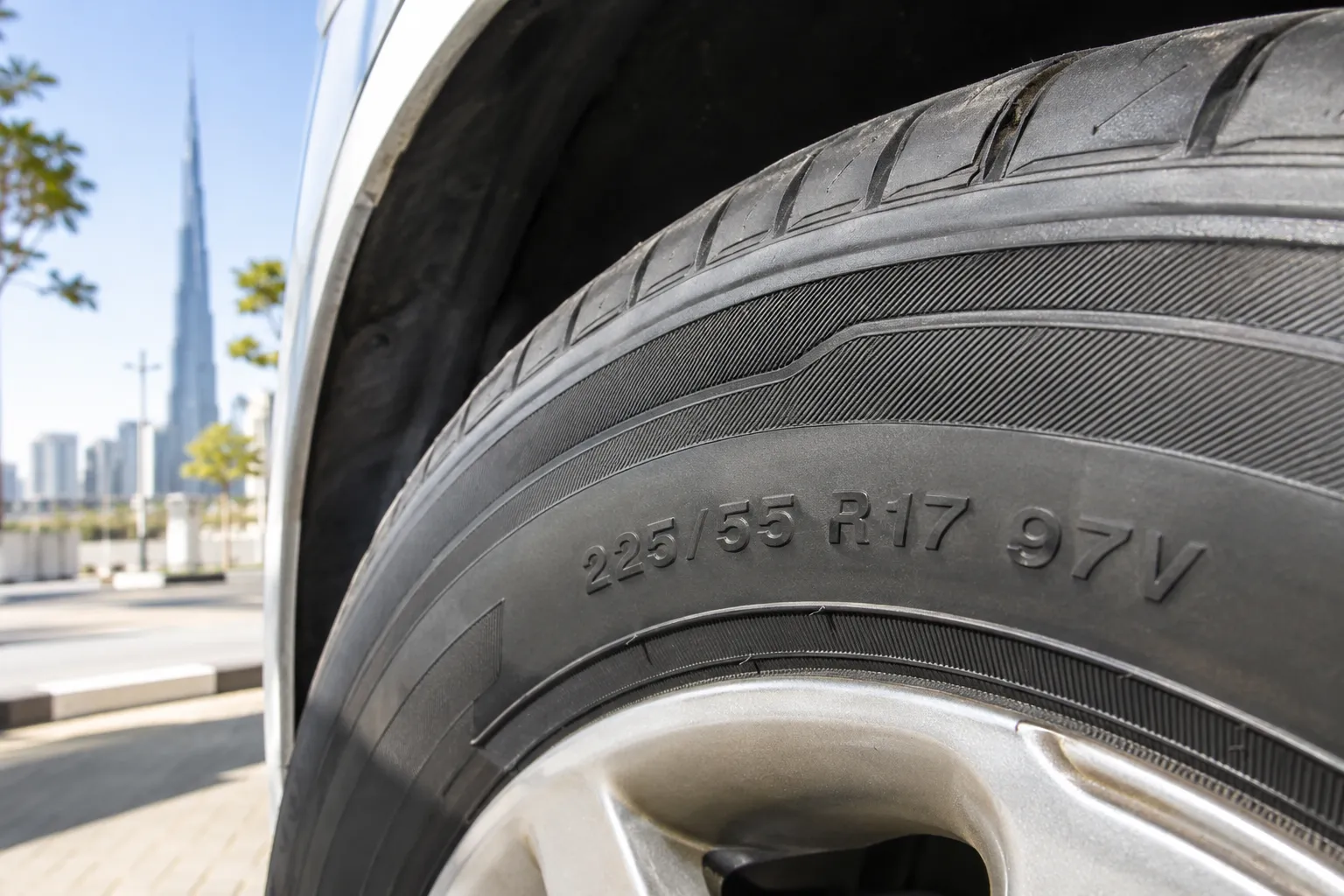
The 3% rule says that if you fit a tyre size different from the one your car came with, its overall diameter should stay within about 3% of the original. Go beyond that and the speedometer reads noticeably wrong, the ABS and stability systems see wheel speeds they don't expect, and the tyre may rub on the arch or suspension.
It's a fitment guideline used across the tyre trade, not a law. The car maker's approved sizes still come first, and the load index and speed rating must be at least as high as the original.
How to work out a tyre’s overall diameter
The diameter is the rim plus two sidewalls. The sidewall height is the width multiplied by the aspect ratio, so a 205/55 R16 has a sidewall of 205 × 0.55 = 112.75 mm. Add two of those to the 16-inch rim (406.4 mm) and the tyre stands about 632 mm tall. Our tyre size guide walks through each number on the sidewall.
Worked examples from a common UAE size
Here's the check applied to 205/55 R16, a size fitted to many compact sedans. The percentages are calculated from the nominal sizes, and real tyres vary by a millimetre or two between brands.
| Alternative size | Overall diameter | Difference | Within 3%? |
|---|---|---|---|
| 205/55 R16 (original) | 632 mm | — | — |
| 195/55 R16 | 621 mm | −1.7% | Yes |
| 215/55 R16 | 643 mm | +1.7% | Yes, check arch clearance |
| 225/45 R17 | 634 mm | +0.4% | Yes, needs 17-inch rims |
| 205/60 R16 | 652 mm | +3.2% | No |
| 225/55 R16 | 654 mm | +3.5% | No |
What goes wrong outside the rule
Tyre too large
- Speedometer reads low: at 3% oversize, an indicated 100 km/h is really about 103
- Rubbing on arches or struts at full lock or over speed bumps
- Slightly duller acceleration, plus extra load on the drivetrain
Tyre too small
- Speedometer reads high and the odometer over-counts
- Less ground clearance on ramps and kerbs
- Lower load capacity if the new size has a lower load index
ABS, traction control and stability control all compare wheel speeds. One mismatched tyre, or a set well outside the original diameter, can make them intervene oddly or switch on a warning light. On four-wheel-drive cars with a centre coupling, mixing diameters between axles can also strain the transmission.
The rule is the minimum check, not the only one
- The car maker lists the size as approved, or it falls within the 3% band of an approved size
- Load index equal to or higher than the original
- Speed rating equal to or higher than the original
- The rim width suits the new tyre width
- Full steering lock and full suspension travel are clear of the bodywork
If you're changing size on an SUV for desert use, all-terrain sizes often run taller. We'd rather check a proposed size against your car before you buy than fit something that rubs. Send us the current size and the one you're considering and we'll run the numbers when you book a tyre replacement.
Thinking of a different size? Send us your current tyre size and the one you want, and we’ll check it fits.
Desert sizes and the 3% rule on 4x4s
Owners of Land Cruisers, Patrols and Wranglers often want a taller all-terrain tyre for sand driving. A bigger tyre does give more ground clearance and a longer footprint when aired down, but it also raises the gearing, reads the speedometer low and can foul the arches when the suspension compresses on a dune. Many 4x4s have a little more room than a sedan, so sizes slightly over 3% are sometimes fitted, but that should be a checked decision, not a guess.
- Turn the steering to full lock both ways and look for contact with the liner or the bumper corner.
- Check clearance with the suspension compressed, not just parked on flat ground.
- Expect the speedometer to under-read; a phone GPS app shows by how much.
- Keep all four tyres the same size, because four-wheel-drive systems are sensitive to diameter differences between axles.
Our off-road and 4x4 tyres page goes further into sizes and tread patterns for sand.
Questions drivers ask
Is the 3% rule a legal limit in the UAE?
No, it is a trade guideline used by tyre fitters worldwide. The legal requirement is that the tyre suits the vehicle and is roadworthy, so stick to the car maker’s approved sizes or close equivalents within the 3% band.
Does the 3% rule apply to width too?
The rule is about overall diameter. Width changes matter for clearance and rim fit, so a wider tyre can pass the diameter check and still rub. Check both.
Can I fit different sizes front and rear?
Only if the car came that way from the factory, as many rear-wheel-drive performance cars do. Otherwise keep the same size on all four, especially on all-wheel-drive cars.
Will a bigger tyre void my warranty?
It can, if the dealer links a fault to a non-approved size. Check the handbook or ask the dealer before changing size on a car under warranty.