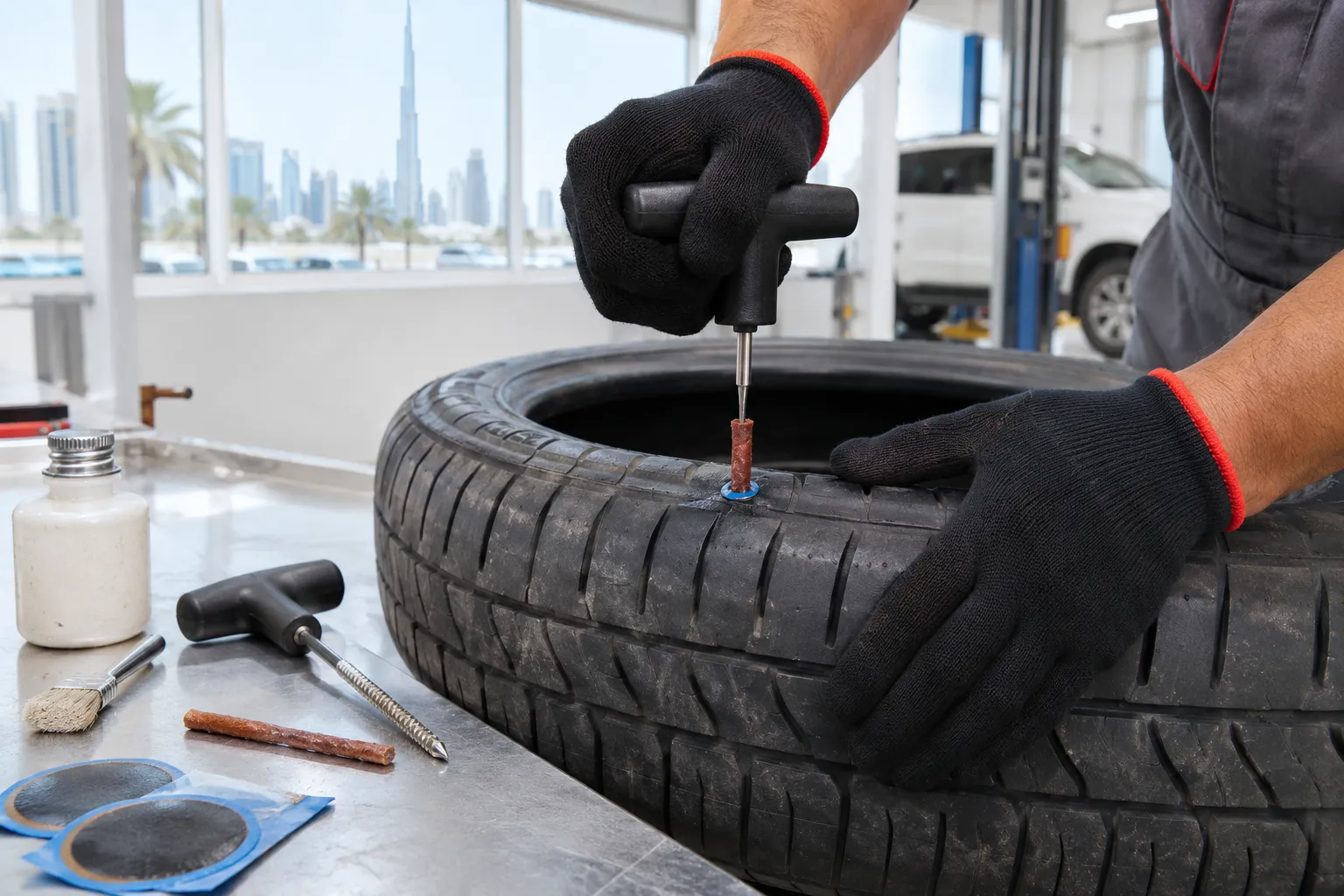
A tyre puncture can usually be repaired if the hole is in the central tread, no wider than about 6 mm, and the tyre has not been driven flat. TireFix repairs punctures in Dubai by taking the tyre off the rim, checking the inside, and fitting a combined plug and patch from the inside, which is the method tyre makers accept as permanent.
If the hole is in the shoulder or the sidewall, the tyre cannot be safely repaired and we will show you why before suggesting a replacement.
When you need it
- The tyre pressure warning light comes on and one tyre reads low
- A screw, nail or piece of metal is visible in the tread
- You top up one tyre every few days
- A hissing sound or bubbles when you spray soapy water on the tread
- The tyre is flat after the car has been parked overnight
What the technician checks
- Where the puncture is: crown, shoulder or sidewall
- Size and angle of the hole once the object is out
- Inner liner for rubber dust or creasing that shows the tyre was driven flat
- Previous repairs nearby, since repairs must not overlap
- Remaining tread depth
- Bead seat and valve, so we are fixing the actual leak
What the starting price covers
- Demounting the tyre and inspecting the inside
- A combined plug-patch fitted from inside
- Remounting, balancing and a leak test
- Pressure set to the placard on all four tyres
What can change the final price
- More than one puncture in the same tyre
- Run-flat or low-profile tyres that need extra care to demount
- A TPMS sensor that needs resealing or replacing
- Call-outs at night or to outlying areas
- A new tyre if the damage turns out to be unrepairable
Where the work is done
A puncture repair needs the tyre off the rim, and the van carries the machine to do that, so we repair it where the car is parked or at the workshop.
Workshops: Al Quoz workshop (Dubai), Sharjah workshop (Sharjah), Mussafah workshop (Abu Dhabi).
Can my tyre puncture be repaired?
Most nail and screw punctures in the middle of the tread can be repaired. The limits below are the ones tyre makers and the US Tire Manufacturers Association publish, and they are the limits we work to.
| Repairable | Not repairable |
|---|---|
| Hole in the central tread | Hole in the shoulder or sidewall |
| Up to about 6 mm across | Larger than about 6 mm, or a cut rather than a hole |
| Tyre stopped soon after losing pressure | Tyre driven flat, with liner damage inside |
| No repair already close by | Overlaps an earlier repair |
| Tread above the wear bars | Tread worn to the wear bars |
We go deeper into the rules, and the grey areas, in can a punctured tyre be repaired.
Why we take the tyre off the rim
A string plug pushed in from outside seals the hole but leaves you guessing about what is going on inside. When a tyre runs low, the sidewall flexes and can grind the inner liner, which weakens the tyre even when the outside looks fine. The only way to see that is to demount it.
How a TireFix puncture repair works
- Find the leakWe spray the tyre and the valve so we repair the right hole, and check there is only one.
- Demount and inspectThe tyre comes off the rim and we look along the inner liner with a light.
- Prepare the holeThe injury is cleaned and reamed along the path the object took.
- Plug-patch from insideA one-piece plug and patch is pulled through and bonded to the liner.
- Refit and testRemount, balance, inflate to the placard and check for bubbles.
Puncture repair across Dubai, Sharjah and Abu Dhabi
Our mobile technicians cover Dubai daily from 7am to midnight, and we take flat-tyre call-outs around the clock on our 24-hour tyre service. The same repair is available in Sharjah and Abu Dhabi, with dedicated pages for puncture repair in Sharjah and puncture repair in Abu Dhabi.
If the tyre is already completely flat, you may want flat tyre repair instead, where we assess first and decide between repairing and fitting the spare.
Send a photo of where the nail or screw is and we will tell you if it looks repairable.
Spotting a slow puncture early
Many punctures in the UAE are slow ones from screws picked up near construction sites and industrial areas. The tyre loses a few PSI a day, which is easy to miss in hot weather when pressures read higher than they are cold.
- One tyre needs more air than the others every time
- The TPMS light comes on in the morning and goes off later
- The car pulls gently to one side
- You can see something shiny in the tread
Our guide to punctures and slow leaks has more on finding them, and how far you can drive on a punctured tyre explains when to stop.
Questions drivers ask
How long does a puncture repair take?
About 30 to 45 minutes for one tyre once the technician arrives, including demounting, the repair, balancing and a leak test. A second puncture in another tyre adds roughly the same again.
Is a repaired tyre safe on the highway?
Yes, when the puncture was in the repairable zone and it was fixed with a plug-patch from inside. Tyre makers treat a correct repair as permanent. A plug pushed in from outside is not, and should be redone.
Should I pull the nail out myself?
No. Leave it in and keep the tyre inflated if you can, because the nail is partly sealing the hole. Pulling it out usually turns a slow leak into a flat.
Can you repair a run-flat tyre?
It depends on the tyre maker and on how far the tyre was driven without pressure. Some makers allow one repair under strict conditions and others say never. See can run-flat tyres be repaired for the details.
Can a sidewall puncture be repaired?
No. The sidewall flexes constantly and a repair there cannot hold, so tyre makers do not allow it. The tyre has to be replaced.
Do you repair punctures in basement car parks?
Usually, yes. We need enough headroom for the van or space to carry the equipment, and a firm level floor to lift the car. Tell us the parking level and any height limit when you book.
Does tyre sealant from a kit ruin the tyre?
Not always, but it has to be cleaned out before a proper repair and some sealants damage TPMS sensors. Tell us if you used a kit so we can bring the right cleaning materials.