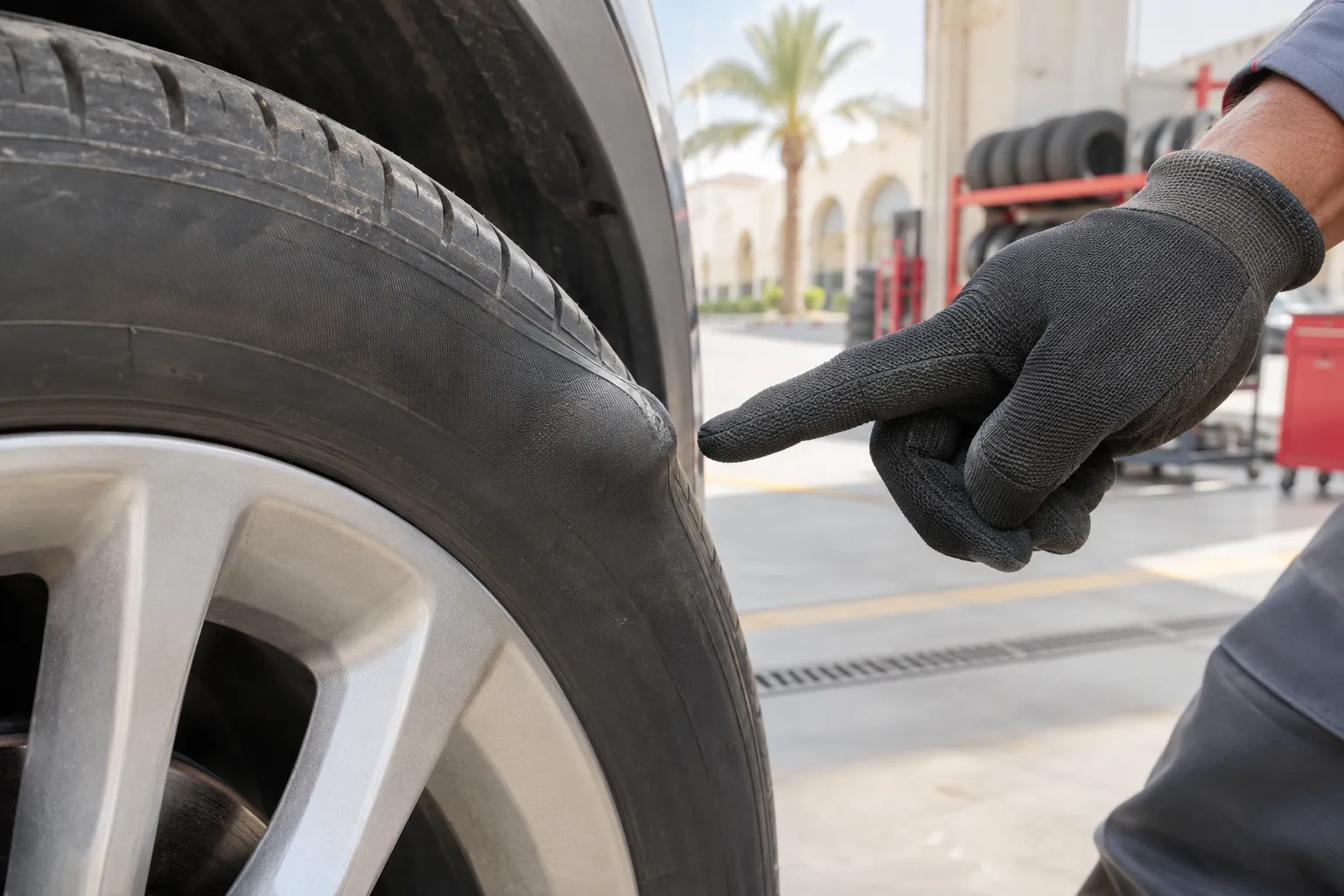
Sidewall damage cannot be repaired. If a cut on the side of the tyre goes deep enough to show fabric or steel cords, or the rubber is torn rather than scuffed, the tyre must be replaced. The sidewall flexes on every rotation, and no repair holds up under that movement.
Light scuffing from parking against a kerb is often cosmetic. The difficulty is telling the two apart, which is why a close look matters.
Cosmetic scuff or real damage?
Usually cosmetic
- A shiny rubbed patch with no depth
- Scuffed raised lettering
- A light line you cannot catch with a fingernail
Replace the tyre
- A cut you can open with a fingernail
- Visible cords or a frayed fabric layer
- A chunk of rubber missing
- Any bulge near the mark
Low-profile tyres on large rims take most of the kerb strikes we see in Dubai, often in tight mall car parks and on basement ramps. If the rim is scraped too, it is worth booking rim repair at the same time, because a damaged rim lip can also cause slow leaks.
Why sidewalls cannot be repaired
Tyre makers and the US Tire Manufacturers Association exclude the sidewall and shoulder from repair. The sidewall carries the car’s weight through constant flexing, and a patch there cannot follow that movement for long. In the UAE heat, a weakened sidewall is a real blowout risk on a long highway drive.
What to do next
Photograph the damage close up and send it with the full tyre size from the sidewall. If it needs replacing, we can bring a matching tyre for a mobile tyre replacement. Replacing one tyre is often fine if the others are close in wear and age.
Questions drivers ask
Can a sidewall puncture be repaired?
No. Industry repair guidelines exclude the sidewall and shoulder. Any puncture or cut there means the tyre must be replaced.
Is it safe to drive with a scuffed sidewall?
A light, shallow scuff with no depth is usually cosmetic. A cut that opens, shows cords, or sits next to a bulge is not safe. If in doubt, have it inspected before driving at highway speed.
Do I need to replace both tyres on the axle?
Not always. If the other tyre on the axle is in good condition with similar tread depth, replacing just the damaged one is usually fine. We measure both and advise.