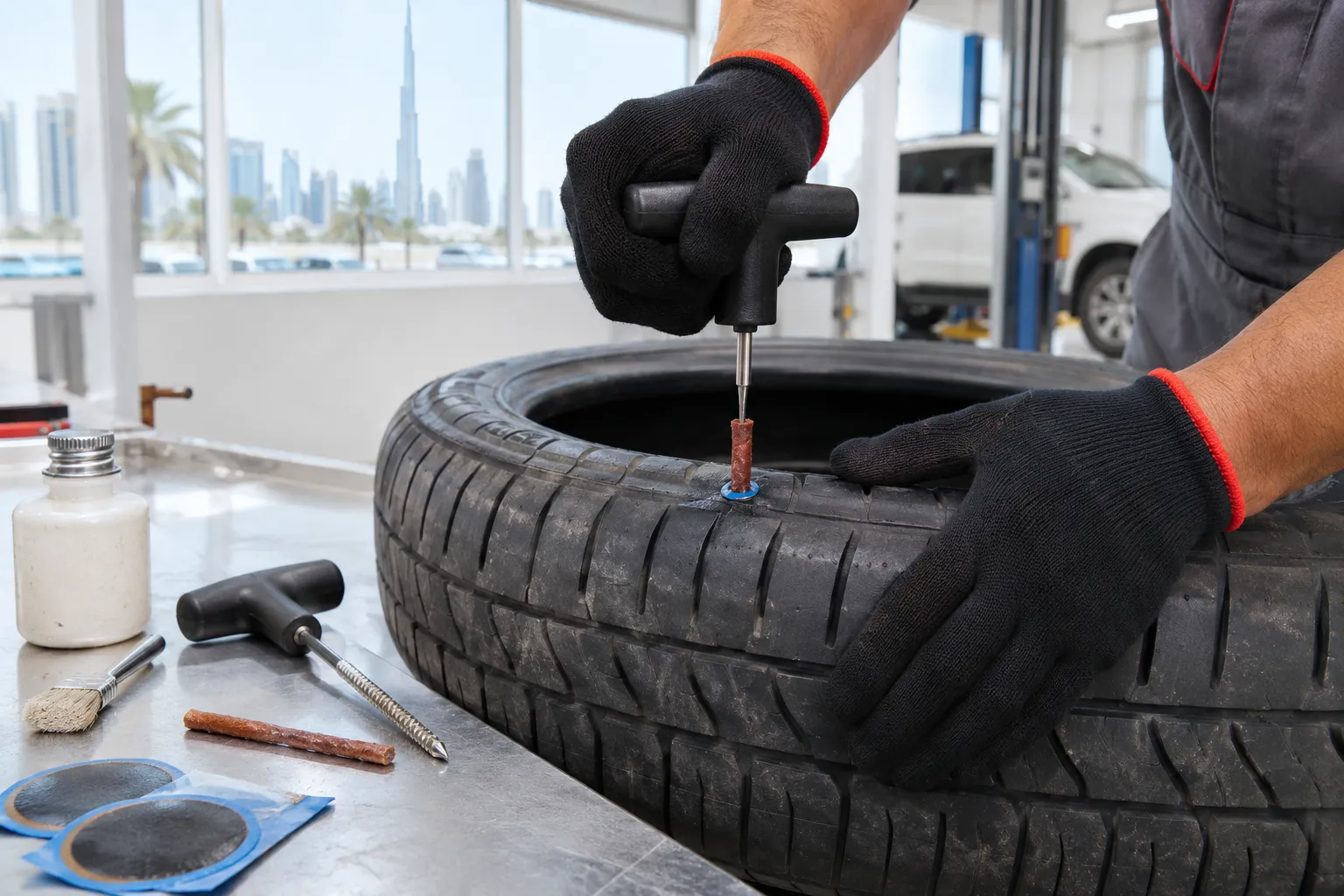
Sometimes, but there is no single rule. Each tyre maker sets its own policy, and many advise against repairing a run-flat or allow it only in limited cases. Bridgestone, for example, says repairability depends on the damage, how much pressure was lost and how the car was driven afterwards. The deciding questions are where the puncture is, whether the tyre was driven with little or no air, and what that specific maker allows.
Run-flats are common on BMWs, MINIs and some Mercedes-Benz and Lexus models on UAE roads, so this comes up a lot. Here is how I approach it.
Why run-flats are harder to repair
A run-flat has stiff, reinforced sidewalls that carry the car’s weight when the tyre loses air. That is what lets you keep driving, typically up to around 80 km/h for about 80 km on many designs (Michelin quotes 50 mph for 50 miles for its ZP tyres). The catch is that the sidewalls flex and heat up during that drive, and the damage they suffer is inside the tyre, where you cannot see it.
A normal tyre that has run flat is usually obviously ruined. A run-flat can look perfect outside after driving flat, which is why makers are cautious about repairs. Read more about the type in run-flat tyres.
What decides whether a run-flat can be repaired
| Question | Why it matters |
|---|---|
| What does this tyre maker allow? | Policies differ. Some refuse all run-flat repairs; others allow one repair under strict conditions. |
| Where is the puncture? | Only damage in the central tread can be considered, as with any tyre. Shoulder and sidewall damage is never repairable. |
| Was it driven with low or no pressure? | If the TPMS warned and the car kept going, the sidewall may be damaged inside. |
| How far and how fast? | A short, slow drive to a safe stop is very different from a long highway run on zero pressure. |
| Has it been repaired before? | Most policies allow few repairs, if any. |
How we inspect a punctured run-flat
- Ask how it was drivenWhen the warning came on, how far you drove and at what speed. This tells us as much as the tyre does.
- Demount and inspect insideRubber dust, creasing or discolouring on the inner liner means the tyre has run flat and is finished.
- Check the maker’s policyWe check the policy for that brand and model before suggesting a repair.
- Repair from inside, or replaceIf a repair is allowed, it is a plug-and-patch fitted from inside, never a string plug from outside.
This is the same process as our puncture repair, with a stricter decision at the end. If the answer is replace, the tyre replacement service covers fitting a new run-flat with balancing.
Can you replace a run-flat with a normal tyre?
Physically, often yes, but think it through. Cars sold on run-flats usually have no spare and no space for one, and the suspension is tuned for stiff sidewalls. If you switch, carry a repair kit or a spare, and keep all four tyres the same type. Do not mix run-flats and normal tyres on the same axle.
Run-flat warning on? Tell us how far you have driven and send a photo of the tyre.
What to do the moment the warning comes on
The single biggest factor in whether a run-flat can be saved is what happens after the pressure warning appears. If you slow down straight away, keep well under the maker’s speed limit and head to a safe stop or a tyre service, the tyre has a far better chance than one driven the full permitted distance at the limit. Note the time and distance when the light came on and tell the technician.
- Reduce speed at once and avoid hard cornering.
- Do not exceed the speed and distance limits in your handbook.
- Do not top up the tyre and carry on as normal; the cause still needs finding.
- If more than one tyre warns at the same time, stop and call for help.
Questions drivers ask
Can a punctured run-flat tyre be repaired?
Sometimes, depending on the maker’s policy, where the puncture is and how the tyre was driven after losing pressure. Many makers advise replacement, especially if the tyre ran with little or no air.
How far can you drive on a run-flat tyre?
It depends on the tyre and the car; many designs allow about 80 km at up to 80 km/h after a puncture. Michelin quotes 50 miles at 50 mph for its ZP run-flats. Check your handbook.
Why do tyre shops refuse to repair run-flats?
Because driving on a deflated run-flat can damage the sidewall internally without visible signs outside. Some makers do not allow repairs for that reason.
Can I put normal tyres on a car that came with run-flats?
Usually yes, but you lose the ability to drive after a puncture and most such cars have no spare. Carry a repair kit or spare, and do not mix tyre types on an axle.