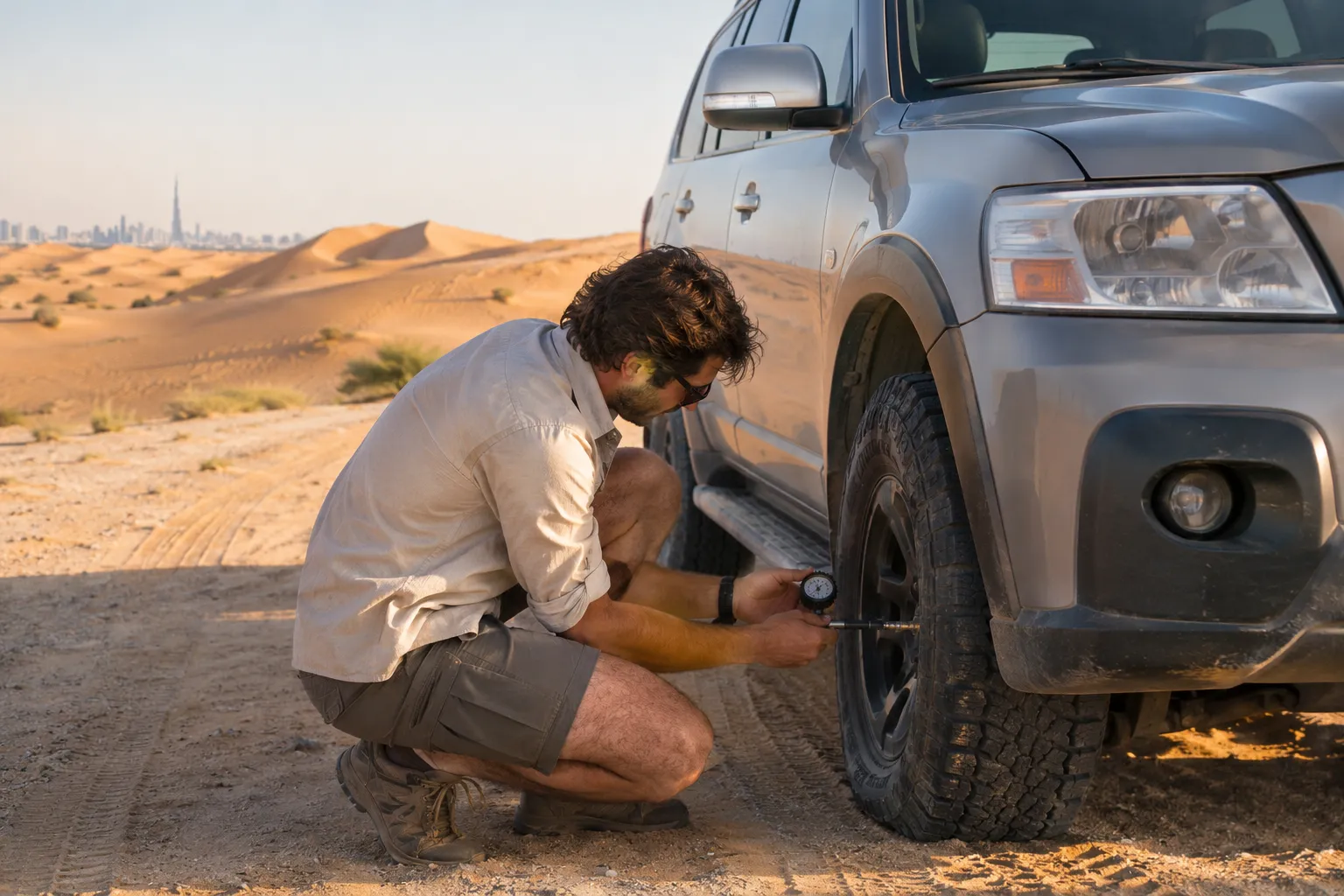
For soft UAE sand, most drivers end up somewhere well below their road pressure. Outdoor and 4x4 guides commonly quote a band of roughly 14 to 20 psi for typical sand driving, but the right figure for your car depends on its weight, tyre size and construction, and on how soft the sand is that day. Tyre makers such as BFGoodrich advise starting from your vehicle maker’s road pressure and lowering it in small steps until the tyre floats. Whatever you drop to, you have to pump back up before you drive on tarmac again.
I would rather you learn the method than memorise a number. Below is how I set pressures for a desert day, what goes wrong when people skip steps, and the kit worth keeping in the boot.
Why lower tyre pressure helps in sand
A softer tyre spreads into a longer, wider footprint. That spreads the car’s weight over more sand, so the tyre rides on top instead of digging a trench. At road pressure the contact patch is short and stiff, which is why a car that drives perfectly on the E66 can bog down in the first soft bowl past the tarmac.
The trade-off is that a deflated tyre flexes much more. Flex makes heat, and it also makes the bead (the edge that seals against the rim) easier to unseat if you turn sharply or hit a ridge at speed. Low pressure is a tool for slow, smooth driving on soft ground, nothing else.
How much should you deflate for UAE sand?
Start from the cold pressure on your door-jamb placard, not the maximum moulded on the sidewall. The tyre pressure guide shows where to find it. From there, BFGoodrich’s own off-road advice is to come down about 0.5 bar (around 7 psi) at a time and test the car on the sand before going lower.
| Situation | Typical starting point | What to watch |
|---|---|---|
| Firm, packed sand track | A modest drop from road pressure | If the car is not sinking, you may not need to go lower |
| Soft dunes and bowls | Commonly quoted band of about 14–20 psi | Lower in steps; check all four tyres match |
| Recovery when already stuck | A further small step down, briefly | Very low pressure risks the bead; drive at walking pace |
Step by step: setting pressures before you leave the tarmac
- Check pressures cold at homeNote each tyre’s cold figure against the placard before the drive, so you know your starting point and can spot a slow leak.
- Stop on firm ground at the sand edgePull fully off the road, away from traffic. Deflate all four tyres to the same figure with a gauge, never by counting seconds.
- Drive a short test loopIf the car still digs in or the engine labours, drop another small step and try again.
- Drive smoothlyAvoid sharp turns at speed and sudden braking on a soft tyre. That is when beads roll off rims.
- Re-inflate before the roadPump back to placard pressure at the sand edge. If you cannot, drive slowly to the nearest air and inflate there.
What happens if you drive on the road at sand pressure
An underinflated tyre at motorway speed flexes hard every revolution and heats up fast. On a summer afternoon, with the road surface already far hotter than the air, that heat builds quickly. You also lose steering precision and braking distance gets longer. BFGoodrich is explicit that aired-down tyres must be re-inflated before you drive on paved roads.
The damage is not always visible straight away. Running soft can crease the sidewall internally, and the tyre may fail days later on a normal commute. If you have driven any distance on tarmac at low pressure, have the tyres looked at. A tyre pressure check includes a visual inspection of the sidewalls.
Kit worth carrying for a desert day
- A good tyre pressure gauge (dial or digital) that reads accurately at low pressures
- A 12V compressor rated for your tyre size, so you can re-inflate at the sand edge
- A deflator tool, which is faster and more even than pressing the valve core
- Spare valve caps, because sand in a valve can cause a slow leak
- Recovery boards and a shovel
- Your spare tyre, checked and at pressure before you leave
Check the spare in particular. A spare that has sat in the boot through a UAE summer is often well under pressure, and a spare tyre fitting is not much help if the spare itself is flat.
After the trip: what to check
Once you are home, wash the sand out of the wheel barrels and look at each sidewall for cuts, scuffs or bulges from rocks hidden in the sand. Check that each valve still holds pressure the next morning. A tyre that has lost a few psi overnight after a desert drive may have a damaged bead seal or a small cut, and our guide to sidewall damage explains which marks matter.
Back from the dunes with a tyre that will not hold pressure? Send us a photo and your location.
Questions drivers ask
What tyre pressure should I use for the desert in the UAE?
There is no single figure. Commonly quoted starting points for soft sand sit around 14–20 psi, but your vehicle’s weight and tyre construction decide what is safe. Start from your placard pressure and lower it in small steps, testing as you go.
Do I need to re-inflate my tyres after desert driving?
Yes. Driving on tarmac at sand pressure overheats the tyre, makes the car less stable and lengthens braking distances. Pump back to the placard cold pressure before rejoining the road, or drive slowly to the nearest air supply.
Can low pressure in sand damage my tyres?
It can if you turn sharply, brake hard or hit ridges at speed on a soft tyre, which can push the bead off the rim or crease the sidewall. Drive slowly and smoothly, and inspect the sidewalls after the trip.
Is it safe to deflate low-profile tyres for sand?
Low-profile tyres gain little footprint from deflation and leave the rim more exposed to damage. Keep drops modest, avoid deep soft sand, and consider tyres designed for off-road use if you go out often.
Should all four tyres be at the same pressure in the sand?
Set them to matching figures with a gauge unless your vehicle maker says otherwise. Uneven pressures make the car pull and can confuse traction control systems.