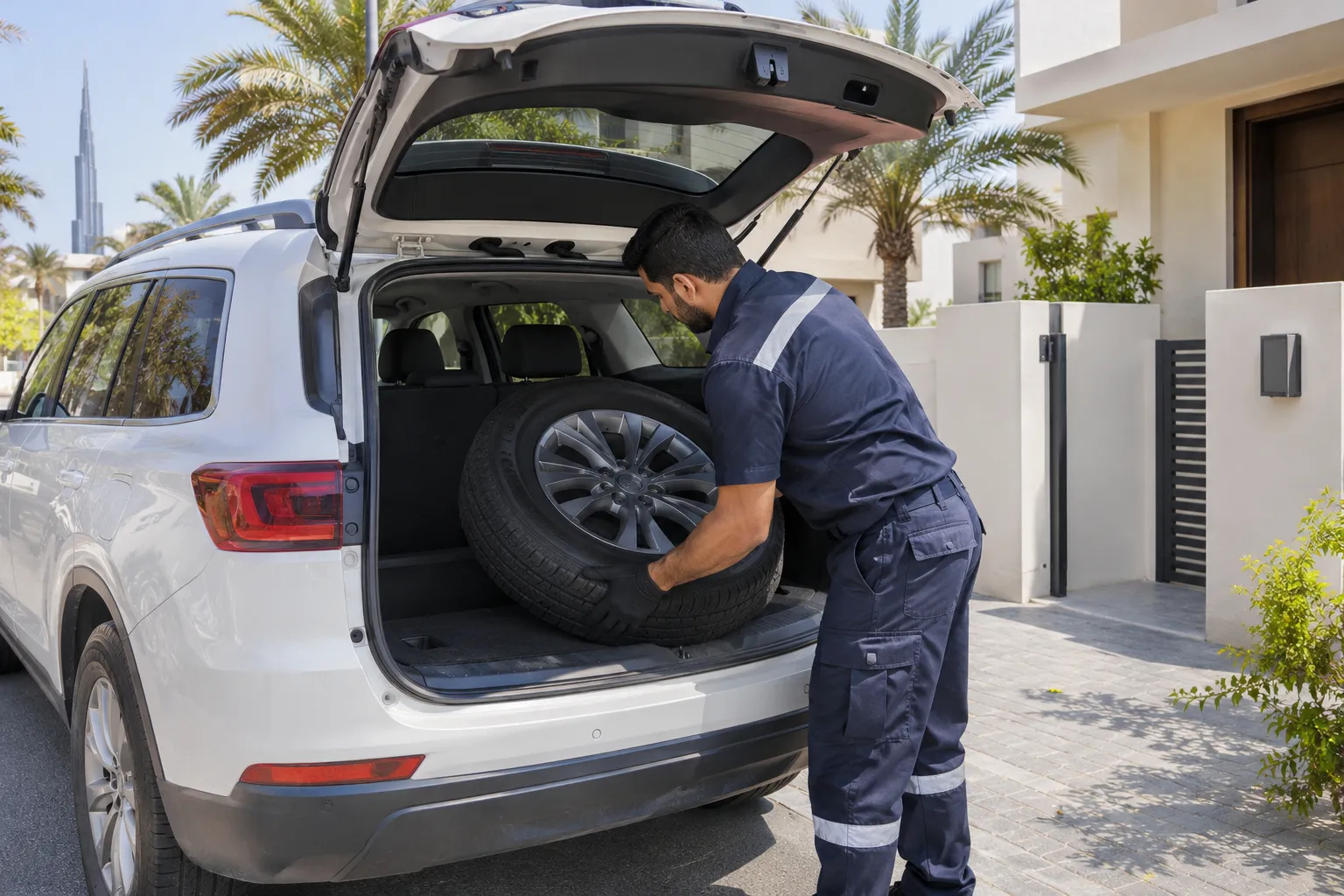
We have not found a UAE traffic rule that requires every car to carry a spare tyre, and many new cars leave the factory with a repair kit or run-flat tyres instead. What UAE law does penalise is driving on tyres that are worn, damaged or expired: police have reported a Dh500 fine, four black points and impoundment under the Federal Traffic Law. So the practical answer is that you do not legally need a spare, but you do need a plan for a flat, and long drives between emirates are where a working spare earns its place.
If your car has a spare, the bigger risk is that it has quietly gone flat or aged out in the boot. That is the one I see most often.
What UAE rules say about tyres
The reported penalties focus on the condition of the tyres on the road: bald or worn tread, visible damage, and tyres past their validity. Khaleej Times has reported tens of thousands of drivers fined for unsafe tyres in a single year. A spare that you fit after a puncture becomes a road tyre the moment it goes on, so the same standards apply to it.
Spare, space saver, run-flat or repair kit: what your car probably has
Full-size spare
- Same size as your road tyres
- Can be used as a normal tyre if it is in good condition
- Common on SUVs and pickups
Space saver
- Narrow, temporary wheel
- Speed and distance limits printed on it, often 80 km/h
- Gets you to a repair, nothing more
Run-flat tyres or repair kit
- No spare at all
- Run-flats let you drive a limited distance after a puncture
- Sealant kits handle small tread punctures only
Run-flats bring their own repair question, which we cover in can run-flat tyres be repaired. For the tyre types themselves, see run-flat tyres.
Why a spare is worth more in the UAE than it looks
- Long stretches between emirates, where help can take a while to reach you.
- Desert weekends, where a sealant kit will not fix a sidewall cut from a rock.
- Summer heat, which makes a slow leak in a road tyre more likely to turn into a flat.
- Sidewall damage from kerbs and potholes, which no sealant can seal.
A repair kit only deals with a small hole in the central tread. If the damage is in the shoulder or sidewall, which our puncture repair zones diagram shows, a kit will not help and you need a wheel change.
Is your spare actually usable? A two-minute check
- Pressure: space savers usually need a higher pressure than road tyres, printed on the tyre or placard
- DOT date: spares age even when unused; NHTSA notes that heat speeds up rubber ageing
- Cracks in the sidewall or between tread blocks
- The jack, wheel brace and locking-nut key are all in the car
- The spare is the right size for the car, not left over from a previous vehicle
Want the spare checked or fitted? We can come to you.
If you have no spare at all
Many drivers here choose not to carry one, and that is a reasonable choice if you mostly drive in the city. Keep your tyre pressures checked so you notice a slow leak early, save a tyre service number in your phone, and know your mobile tyre service options. If you do want a spare, we can supply a correctly sized wheel and tyre. Our spare tyre fitting service covers fitting your existing spare at the roadside or at home.
Questions drivers ask
Is it mandatory to have a spare tyre in the UAE?
We have not found a UAE rule that requires a spare, and many new cars come with a repair kit or run-flat tyres instead. Check with the RTA or your emirate’s police if you need a definitive answer for an inspection.
Can I be fined for a bad spare tyre?
If you fit the spare and drive on it, it must meet the same standards as any road tyre. Worn, damaged or expired tyres can bring a Dh500 fine and four black points under the Federal Traffic Law.
How long can I drive on a space-saver spare?
Only as far as you need to reach a repair, within the speed and distance limits printed on the wheel or in the handbook. Many are limited to about 80 km/h.
Does a spare tyre expire?
Yes. Rubber ages with time and heat whether or not the tyre is used. Check the DOT date and replace a spare that is beyond the age your tyre maker recommends.