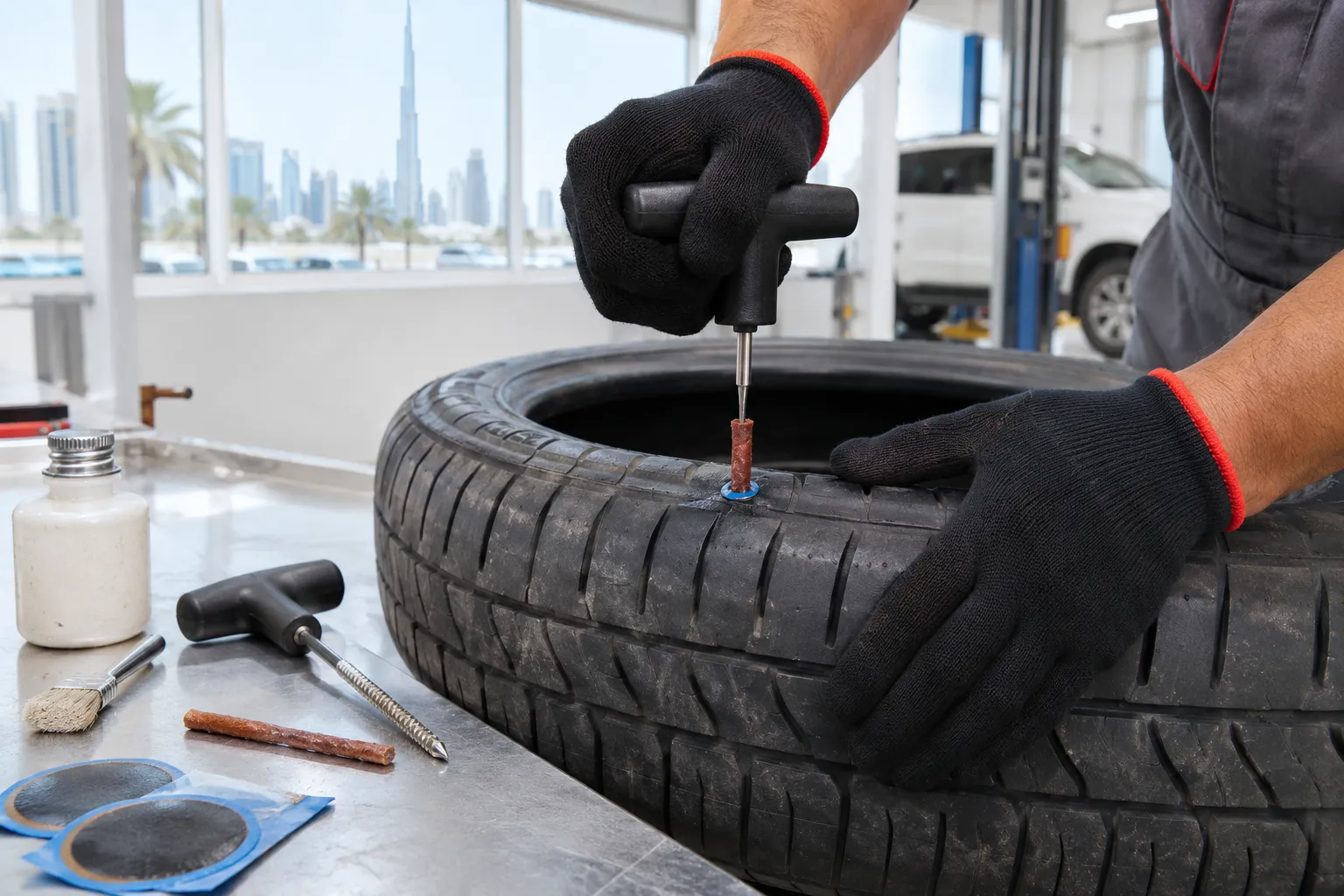
The usual sign of a puncture is a tyre that needs air more often than the other three, or a TPMS warning that returns a day or two after you top up. Most car punctures are caused by nails, screws or sharp metal picked up from the road, and in the UAE construction debris near new communities is a common source.
A puncture in the central tread, no larger than about 6 mm, can normally be repaired properly from inside the tyre. A puncture in the shoulder or sidewall cannot.
Signs you have a puncture
- One tyre reads lower than the others at every check.
- The TPMS light comes back soon after you reinflate.
- You can see a nail or screw head in the tread.
- The car pulls slightly towards one side, or the steering feels heavy.
- A hissing sound when parked, or bubbles if you spray soapy water on the tread.
Slow leaks are not always punctures. Air can also escape from a corroded rim bead, a cracked alloy or a tired valve. Our technicians check those too, because a plug in the tread will not fix a leak at the rim.
Where a puncture can and cannot be repaired
Tyre industry guidance limits repairs to punctures of up to 6 mm (¼ inch) in the tread area, away from the shoulder. The repair must combine a rubber stem that fills the hole with a patch bonded to the inner liner. A plug alone, pushed in from outside, is not a proper repair. Our article on whether a punctured tyre can be repaired explains the rules in detail.
What to do now
- Check how fast it is losing airIf the tyre is holding most of its pressure, top it up and get it repaired the same day.
- If it is flat, do not drive on itDriving on a flat destroys the sidewall within a short distance, turning a cheap repair into a new tyre. Fit the spare or request a flat tyre call-out.
- Avoid sealant cans if you want a repairSome temporary sealants make a proper inside repair harder. Tell the technician if one was used.
Spotted a nail? Send a photo and your location.
Questions drivers ask
Can I keep driving with a slow puncture?
Only for a short distance at the correct pressure, and only to get it repaired. A slow leak can become a fast one, and an under-inflated tyre overheats. Read how far you can drive on a punctured tyre for the limits.
How big a puncture can be repaired?
Industry guidance allows repairs up to 6 mm (¼ inch) in diameter in the central tread area. Larger holes, or any damage in the shoulder or sidewall, mean replacement.
Is a tyre plug safe?
A string plug fitted from outside is a temporary fix only. A proper repair removes the tyre from the rim, inspects the inside, and fits a combined plug and patch. That is the method we use.